Two new publications highlight a critical moment for EU pollinator policy. While restoration goals are becoming clearer, policy coherence and regulatory stability remain major challenges.
A joint white paper produced by eight EU-funded pollinator projects, calls for “pollinator stewardship in all policies” as a guiding principle for European decision-making. Pollinator stewardship is the responsibility and mindset to care for pollinators, their habitats, and the sustainable use of their services in all we do. Meanwhile, a recently published article in Science, in which over 30 European researchers warn of the risks associated with the EU Omnibus Food and Feed Safety Simplification Package that could weaken environmental protection and undermine evidence-based decision-making.
Together, these publications provide timely insights and opportunity for scientific evidence to influence and shape policy as Member States prepare to implement the EU Nature Restoration Regulation. As they develop strategies to halt and reverse pollinator decline, what remains a challenge in achieving those commitments is policy coherence across the different sectors.
Policy stewardship in all policies
Pollinators are essential for increasing biodiversity, which leads to ecosystem resilience, along with crop services which support food security. Yet despite growing recognition of their importance, many pollinator populations continue to decline across Europe due to key drivers, such as climate change, invasive species, land use change, intensive management, and increased pollution.
The new white paper argues that one of the biggest barriers to pollinator recovery is policy incoherence. While the European Union has adopted ambitious biodiversity objectives, including legally binding targets under the Nature Restoration Regulation, many policies affecting agriculture, pesticides, food systems, trade and innovation remain insufficiently aligned with pollinator restoration goals.
The authors argue that pollinator stewardship should become a central principle across all pollinator-relevant policy domains. Rather than treating pollinator conservation as a narrow environmental issue, the paper advocates educating professionals in all key sectors that affect pollinators and their habitats. Since reversing these trends will require not only habitat restoration and reduced environmental pressures, but also improved governance, stronger stakeholder participation, better integration of scientific knowledge into policy making, and greater coordination across sectors and levels of government.

A timely warning against weakening pesticide safeguards
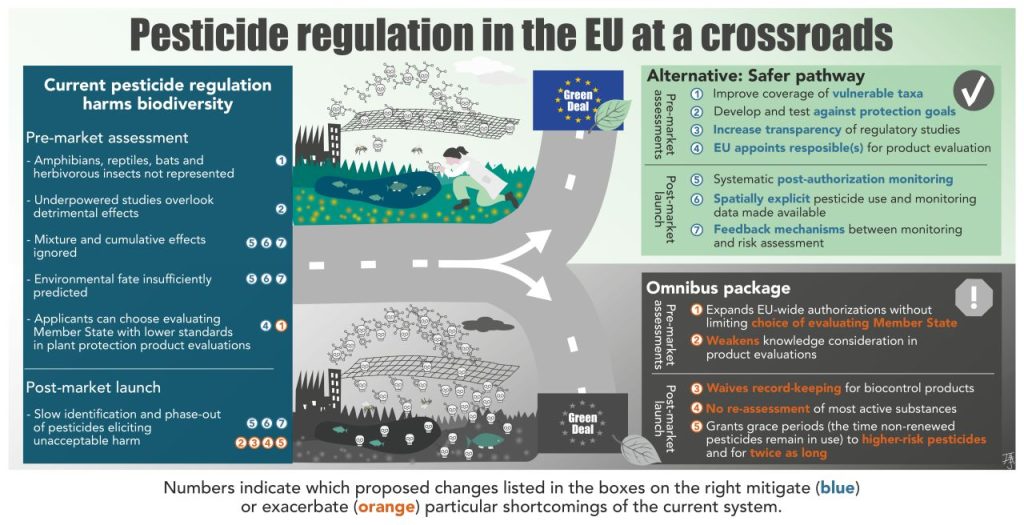
A recent Science article focuses on a more immediate policy debate, where researchers examine proposed changes to pesticide regulation contained within the European Commision’s draft Omnibus legislative package. According to the authors, some of the proposed reforms could weaken key safeguards that currently form part of the EU pesticide approval system.
The researchers acknowledge that improving efficiency and reducing unnecessary administrative burdens are legitimate policy goals. However, they stress that simplification should not come at the expense of scientific rigor, environmental protection, or public health. Instead, they propose reforms that would strengthen regulatory effectiveness while maintaining the scientific foundations of pesticide risk assessment.
For pollinators, the stakes are particularly high. Exposure to pesticides remains one of several interacting pressures contributing to pollinator declines, alongside habitat loss, climate change and landscape simplification. The authors therefore caution that regulatory changes should be carefully evaluated to ensure they do not inadvertently increase risks to biodiversity.
A shared message – implementation matters
Although the two publications address different policy challenges, they arrive at a remarkably similar conclusion.
The white paper presents a broad vision for embedding pollinator stewardship across all relevant policy areas. The Science article provides a concrete example of why such stewardship matters in practice, demonstrating how regulatory reforms in one sector can have implications for pollinator restoration goals elsewhere
In both cases, the authors emphasize that successful pollinator restoration depends not only on setting goals, but also on policy coherency, ensuring that policies are aligned, evidence-based and capable of supporting implementation on the ground.
This message is particularly relevant as European countries begin translating the Nature Restoration Regulation into national action plans. Effective pollinator restoration will require coordinated action across sectors, long-term policy stability and decision-making informed by the best available science.
The two new publications demonstrate the importance of complementing ecological restoration efforts with effective governance. As Europe moves from ambition to implementation, ensuring policy coherence and maintaining strong environmental safeguards will be essential for delivering meaningful outcomes for pollinators, biodiversity and society.
Further reading
- van der Sluijs et al. (2026). Towards pollinator stewardship in all policies: Policy incoherence in the EU is a major barrier to pollinator restoration (Preprint). Zenodo. https://doi.org/10.5281/zenodo.20715670
- Wintermantel et al. (2026). EU Omnibus proposal increases pesticide risks. https://doi.org/10.1126/science.aeg8744