Researchers at Wageningen University are involved in the Boshommellandschap Geuldal initiative, a living lab that was established in 2018. The growing group of twelve (12) partners include municipalities, farmer organizations, nature organizations, a water board, a drinking water company, a province and researchers. Their focus is on implementing bee-friendly management in four different habitat types following a learning-by-doing approach.
Activities within the Living Labs
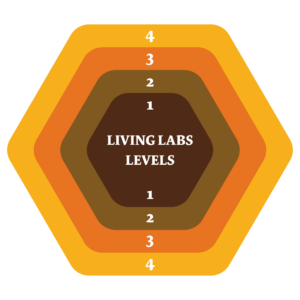
Within the Living Lab network, we are conducting an array of different activities at different levels. These include:
Level 1
The center level contains activities that are conducted at the living labs but coordinated by RestPoll members (i.e. pollinator monitoring).
- Pollinator and vegetation monitoring (Task 1.2a)
- Pollination monitoring (Task 1.2b)
- Measuring the effect of co-design (Task 1.3)
- Rapid assessment of plants and pollinators (Task 1.4)
- Evaluate interactions among landscape-scale drivers and local restoration measures on pollinators (Task 2.2)
- Identify synergies and opportunities for improvements of current restoration implementations (Task 2.3)
Level 2
The second level contains activities that are conducted within the living lab with all stakeholders involved (i.e. workshop to discuss implementation of co-designed measures).
- Assess co-benefits of pollinators restoration measures and the direct and indirect impacts of restoration measures on bio-economy (Task 2.4 + 3.3)
- Develop and test a novel instrument based on Payments for Restoration-mediated Pollination Services (PRPS) (Task 3.2)
- Establishing and monitoring progress and knowledge flow with the Living Lab (Task 4.1)
- Assessing enabling conditions for pollinator restoration measures (Task 4.3)
Level 3
The third level are activities that are conducted within the living lab during demonstration events, including a larger audience (i.e. workshop on horizon scan).
- Horizon scanning of strengths, weaknesses, opportunities & threats for pollinator restorations (Task 4.4)
Level 4
The final level includes activities that involve the general public within the living lab vicinity (i.e. testing of feasibility of tools).
- Assessing the awareness of pollinators and willingness to protect them (Task 3.1)
- Estimate the value added by wild pollinators to the food value chain (Task 3.4)
- Test and evaluate tools for the RestPoll toolbox of restoration methods (Task 5.2)
- Survey consumer willingness to purchase biodiversity-friendly products (Task 5.3)
- Understanding and evaluating the co-design of pollinator-friendly labels (Task 5.4)
About this Living Lab
Implementations
Bee friendly management is co-designed with the partners who are responsible for the implementation of the management. Different habitat types have different types of bee-friendly management. This includes staggered mowing (not everything at the same time) of road verges and low-intensity pastures, delayed grazing of water retention sites as well as establishment of earth banks for ground nesting bees, and the establishment of wildflower strips or blocks on arable land.
Main landuse types
Mixed farmland
Pollinator dependent crops
Apple, pear


Researchers

Remco Ploeg
David Kleijn
Jeroen Scheper
Contact us for collaboration

Alexandra Klein
alexandra.klein@nature.uni-freiburg.de