As winter fades and the first warm days of spring arrive, gardens, landscapes, parks, tree pockets and the like begin to buzz with life again. Among the most important visitors returning to these areas are essential pollinators that support both natural ecosystems and our food supply [1].
While honeybees often receive the most attention, most pollination is actually carried out by wild pollinators such as bumblebees, mason bees, and many other pollinator species [1]. In Central Europe alone there are hundreds of wild bee species [1], not to mention the additional hundreds of other wild pollinators such as hoverflies and butterflies [2,3]. They each have unique nesting habits and food preferences and their diversity makes them especially effective pollinators for many flowering plants and crops [1].
Why Spring Matters for Pollinators
For wild pollinators, early spring is a critical time [1]. Many species emerge from winter needing access to nectar for energy and pollen to feed their developing offspring. Without early flowering plants, it becomes difficult for pollinators to establish nests and build healthy populations for the rest of the season [4].
Trees and shrubs are often the first major food sources. Willows, fruit trees such as apple and cherry, and early flowering shrubs provide abundant pollen and nectar that sustain pollinators when few other plants are blooming [1].
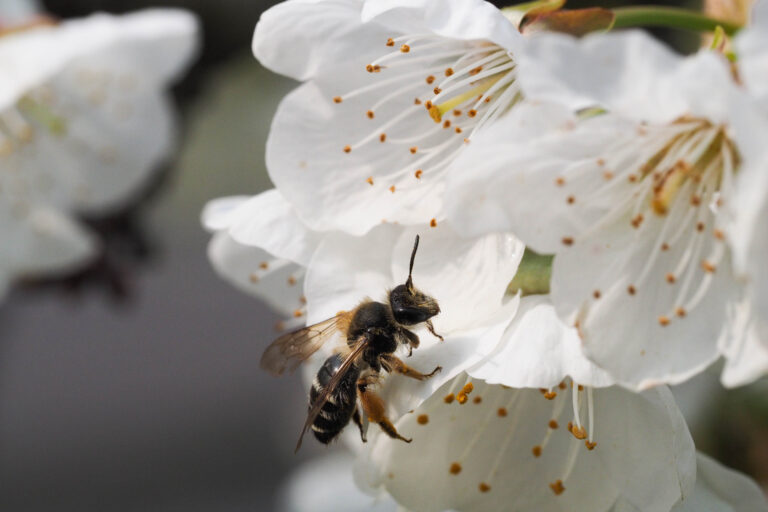
Photo by Felix Fornoff.
Creating Habitat in Everyday Spaces
Wild pollinators not only need flowers but also safe places to live. Many species nest in the ground, while others use hollow stems, wood cavities, or natural crevices [1]. Even small urban green spaces, such as gardens, park edges, and tree pockets, can become important refuges for pollinators.
Simple steps can make a big difference [5]:
- Leave small patches of bare soil for ground-nesting bees
- Keep some plant stems standing through winter
- Allow fallen wood or natural corners to remain undisturbed
Companion Plants for Pollinators
Planting a variety of flowering plants ensures bees and other wild pollinators have food from early spring through summer. Many of these plants also serve as excellent companions in gardens and orchards.
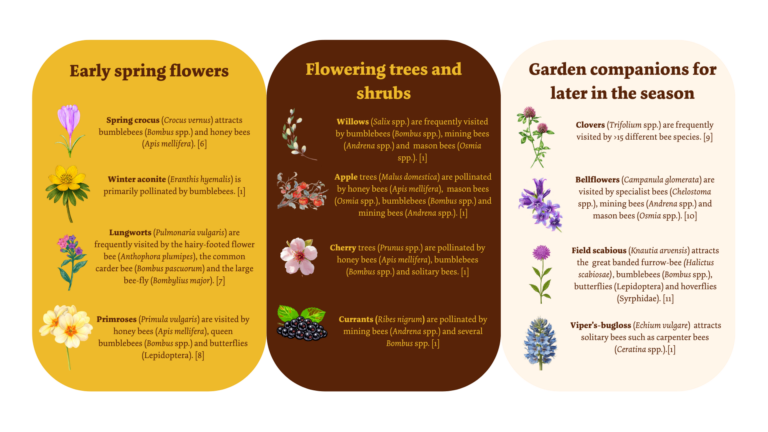
Infographic created with Canva Pro.
A Shared Garden
Supporting wild pollinators does not require large landscapes or complex planning. A few early blooms, a diversity of flowering plants throughout the season, and small nesting habitats can transform gardens and public green spaces into welcoming environments for these important insects. With each visit to a flower, wild pollinators quietly sustain the plants that shape our landscapes and nourish our communities.
References
[1] Klein, A.-M., & Fornoff, F. (2025). Praxishandbuch Nutzpflanzenbestäubung: Ertragssteigerung durch Förderung der Biodiversität (1. Auflage). Haupt Verlag. https://www.haupt.ch/buecher/natur-garten/praxishandbuch-nutzpflanzenbestaeubung.html
[2] Sentil, A., Miličić, M., Benrezkallah, J., Ačanski, J., Andrić, A., Aubert, M., Bartomeus, I., Biella, P., Boustani, M., Carstensen, L. B., Bogusch, P., Bot, S., Brau, T., Budrys, E., Salazar, L. C., Cappellari, A., Carion, F., Castro, S., Cavaillès, S., … De Manincor, N. (2026). Synthesised database of wild bee and hoverfly records in Europe. Scientific Data, 13(1), 227. https://doi.org/10.1038/s41597-026-06644-2
[3] European Commission. Directorate General for Environment. (2025). European red list of butterflies. Publications Office. https://data.europa.eu/doi/10.2779/935927
[4] Harris, C., Balfour, N. J., & Ratnieks, F. L. W. (2024). Seasonal variation in the general availability of floral resources for pollinators in northwest Europe: A review of the data. Biological Conservation, 298, 110774. https://doi.org/10.1016/j.biocon.2024.110774
[5] Dar, S. A., Saad, M., Hasan, W., Devi, Y. K., Ridouane, F. L., Alyammahi, K., Masry, S. H. D., Bumpy, K., Javeed, K., Hussein, H. S., & El‐Samad, L. M. (2025). Solitary Bees as Vital Bioindicators: A Comprehensive Review of the Diversity, Decline, and Conservation Imperatives of the Halictidae Family. Entomological Research, 55(6), e70047. https://doi.org/10.1111/1748-5967.70047
[6] Totland, Ø., & Matthews, I. (1998). Determinants of pollinator activity and flower preference in the early spring blooming Crocus vernus. Acta Oecologica, 19(2), 155–165. https://doi.org/10.1016/S1146-609X(98)80019-2
[7]: Meeus, S., Brys, R., Honnay, O., & Jacquemyn, H. (2013). Biological Flora of the British Isles: Pulmonaria officinalis. Journal of Ecology, 101(5), 1353–1368. https://doi.org/10.1111/1365-2745.12150
[8]: Deschepper, P., Brys, R., & Jacquemyn, H. (2018). The impact of flower morphology and pollinator community composition on pollen transfer in the distylous Primula veris. Botanical Journal of the Linnean Society, 186(3), 414–424. https://doi.org/10.1093/botlinnean/box097
[9]: Hederström, V., Johansson, S., Rundlöf, M., Svensson, G. P., Anderbrant, O., Lundin, O., Larsson, M. C., & Lankinen, Å. (2024). White clover pollinators and seed set in relation to local management and landscape context. Agriculture, Ecosystems & Environment, 365, 108933. https://doi.org/10.1016/j.agee.2024.108933
[10] Schlindwein, C., Wittmann, D., Martins, C. F., Hamm, A., Siqueira, J. A., Schiffler, D., & Machado, I. C. (2005). Pollination of Campanula rapunculus L. (Campanulaceae): How much pollen flows into pollination and into reproduction of oligolectic pollinators? Plant Systematics and Evolution, 250(3–4), 147–156. https://doi.org/10.1007/s00606-004-0246-8
[11] Ollerton, J., Coulthard, E., Tarrant, S., Woolford, J., Jorge, L. R., & Rech, A. R. (2025). Butterflies, bumblebees and hoverflies are equally effective pollinators of Knautia arvensis (Caprifoliaceae), a generalist plant species with compound inflorescences. Journal of Applied Entomology, 149(5), 685–696. https://doi.org/10.1111/jen.13345