To guide and assist local practitioners to national and international governmental agencies in the endeavor to stop and reverse pollinator decline, the RestPoll project has summarized expert knowledge on what really works to protect pollinators. The policy brief is intended for everyone interested in pollinator restoration and the Nature Restoration Regulations.
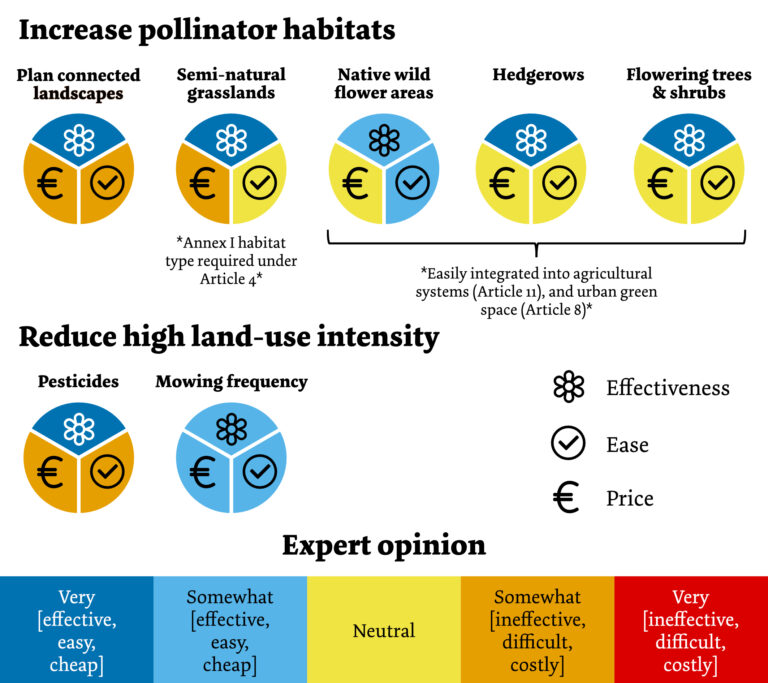
To meet Europe’s Nature Restoration goals across Europe, the project asked international pollinator experts to identify what truly supports pollinator recovery, from which two big themes emerged. For successful restoration of pollinator communities, it is important to
Pollinators need more suitable habitats. Improving the quality of existing habitats, for example, by using less pesticide and adapted mowing and grazing systems also supports pollinator populations. Recent research has found that when the overall habitat area is low, increasing habitat quantity has the greatest impact. Whereas when there is more habitat availability, increasing the quality leads to greater benefits than adding more habitat. Implementation of these measures not only strengthens pollinator populations but also enhances our environmental and economic resilience.
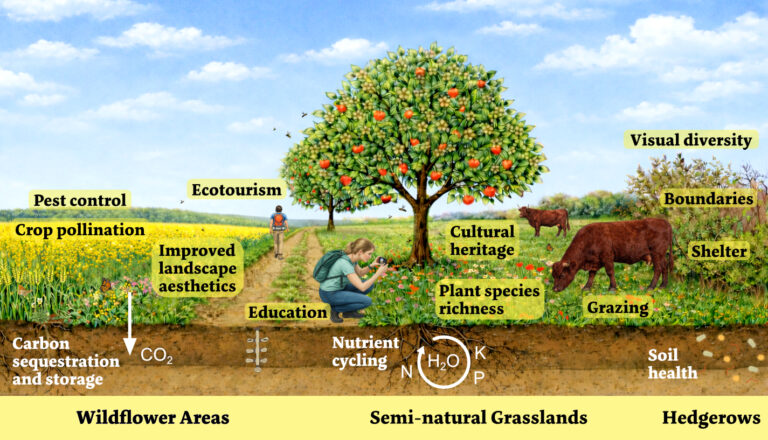
Implementing measures to restore pollinator communities does not just affect the pollinators but extend to beyond habitat. For example, planting a flower meadow increases the biodiversity of plants and insects in the area, but can increase soil health, prevent erosion, and improve the community’s well-being through its aesthetics, as shown in the picture below. Pollinator restoration can be both ecologically rewarding and cost-effective.
There is no “standard solution” for success: measures are particularly successful when they are adapted to local conditions such as soil, climate, landscape structure, and target species. Practical implementation can be ensured when key stakeholders, such as ecologists, farmers, lands managers, and local authorities are simultaneously involved can increase the likelihood that measures are appropriate, effective, and sustainable.
You can also contribute to the change by getting involved in a local conservation project, supporting pollinator communities in your own backyard, or contacting your local politicians to advocate on behalf of the pollinators.
For examples of successful local actions, check out our new field work article.
Original publication:
Knapp, J., Dicks, L., Kranke, N., Morgan, W., Potts, S., Smith, H.G., Stout, J., Thijssen, M., Thompson, A., Klein, A.M. (2026). Restoring pollinators in Europe: Evidence- based actions for Nature Restoration Plans. Policy brief written by RestPoll (EU Horizon project No. 101082102). Zenodo. https://doi.org/10.5281/zenodo.18655302
Now available in
German: https://zenodo.org/records/18837761
Greek: https://doi.org/10.5281/zenodo.19609010
Hungarian: https://doi.org/10.5281/zenodo.19255037
Latvian: https://doi.org/10.5281/zenodo.19183882
Ukrainian: https://doi.org/10.5281/zenodo.19594483