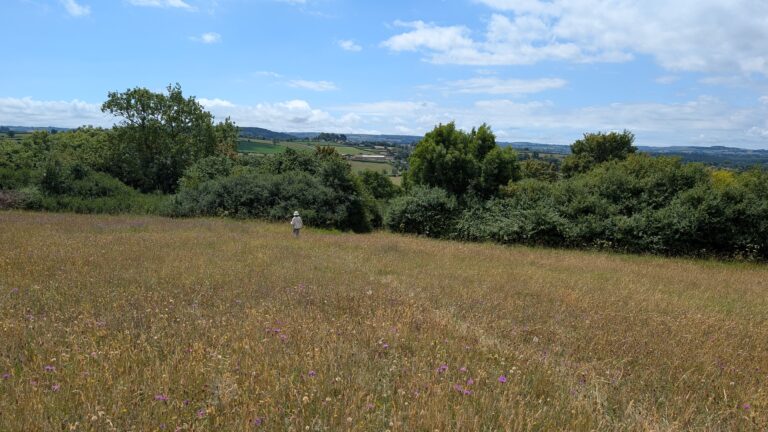
Photo from Annie Northfield.
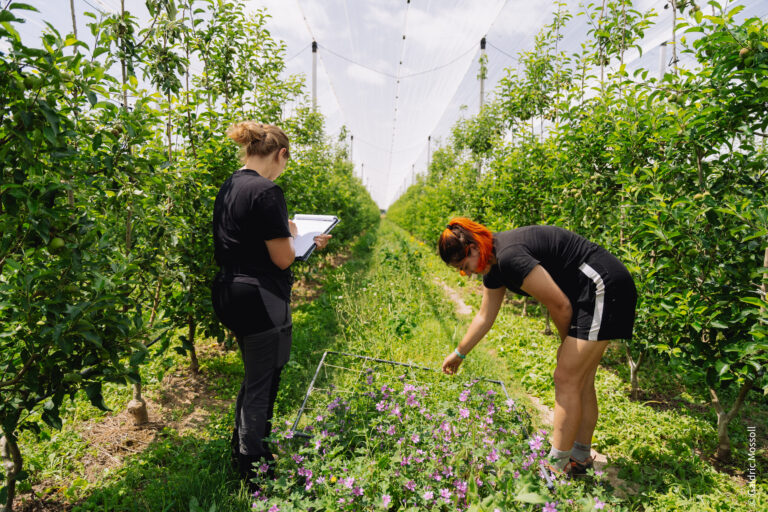
Photo by Galdric Mossoll.
The RestPoll project is monitoring the implementation of several local restoration actions. Due to different landscape contexts, the actions vary from improving nesting habitats for pollinators and floral resources to changes in management. The empirical evaluation of the effectiveness of these different measures on restoring pollinator communities is still being evaluated. However, first analyses have shown that there is success of these local actions.
Semi-natural grasslands are a valuable habitat in Europe through their species-rich, traditional, low-intensity cultural landscapes. Presently, over 90% of species-rich meadows have disappeared in some regions. This is due to intensification of agricultural management (e.g. increase fertilizer use and frequent mowing), land abandonment, or urban expansion. Meadows, such as the one featured below, can be restore through effective local actions, such as late mowing or reduced grazing. For example, when mowing or grazing is reduced or delayed, this allows plants time to grow and bloom. Subsequently this increases diversity and provides a continuous food, nesting or breeding area, and protection for pollinators, small mammals, birds, and amphibians.
RestPoll partners from the University of Cambridge are monitoring meadows that are mown late in the season and grazed in the fall. From their first analysis, they found there are more pollinators on the meadow restoration sites which are managed in partnership with conservationists. This is especially true in the late summer, when cutting can really reduce the available number of flowers.
Fruit orchards, especially apples, support pollinators by providing resources early in the spring when there is not much else blooming. However, after these fruit trees are done blooming, there is usually a lack of resources to continue supporting these pollinators. Planting native flowering plants or cover crops between the trees can provide food resources for pollinators, but can also lead to additional benefits, such as improved soil health and natural enemy protection [1,2].
RestPoll Partners at Center for Ecological Research and Forestry Applications and Institute of Agrifood Research and Technology in Catalonia, Spain and at the University of Freiburg in Germany are monitoring these measures in different apple orchards. Both partners have found that these measures help increase the abundance and species of pollinators in these habitats, and additional resources help support the communities throughout the summer.
Restoration of pollinator habitats can come in many forms; what is important is the context of the local landscape. Reducing management can increase the health of the habitat and support not only pollinator communities but also leads to additional benefits. Additionally, diversifying a landscape helps support pollinator community and can help improve crop yield [1,3].
For more information on successfully implementing restoration measures, check out our recently published policy brief and In Practice article. For more local actions, check out this article from collaborative partner, FarmBioNet.
References
[1] Fijen, T.P.M. et al. Crop diversification for pollinator conservation. Landsc Ecol 40, 19 (2025). https://doi.org/10.1007/s10980-024-02027-3
[2] Zhang, X. et al. Intercropping flowering plants facilitate conservation, movement and biocontrol performance of predators in insecticide-free apple orchard. Agriculture, Ecosystems & Environment 340, 108157 (2022). https://doi.org/10.1016/j.agee.2022.108157
[3] Sritongchuay, T. et al. Crop diversity in the landscape boosts pollinators and yield of pollinator dependent crops across the world. Agriculture, Ecosystems & Environment 395, 109943 (2026). https://doi.org/10.1016/j.agee.2025.109943